How Amoeba Works
How Amoeba Creates CAD Library Components
Amoeba uses Large Language Models, language models, and engineering reasoning to transform supplier documentation into validated CAD components, automatically.
Let Amoeba do the work.
You keep building.
Request a demoDeep dive, Amoeba process
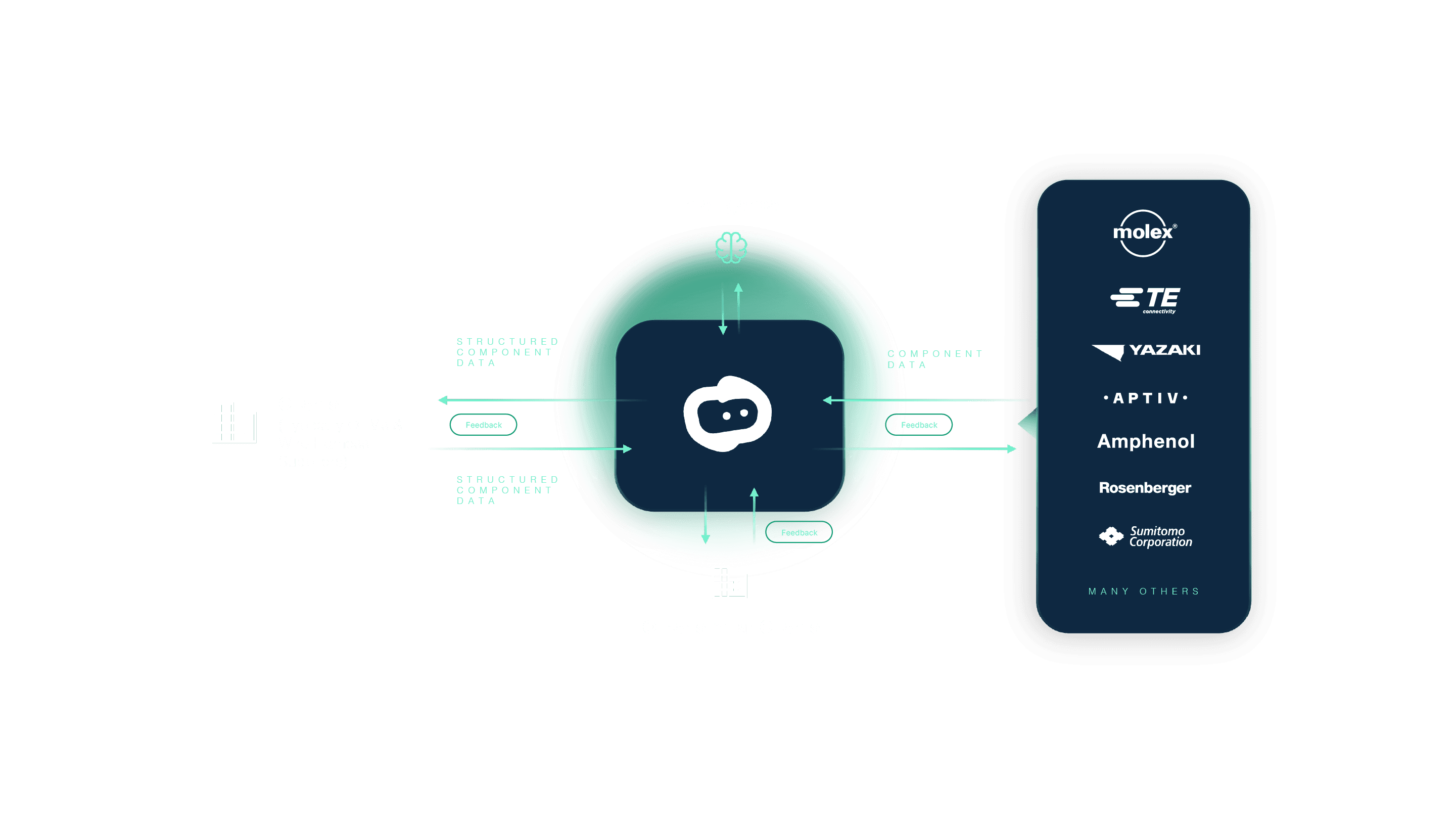
Amoeba orchestrates multiple AI processes that transform raw supplier data into validated CAD-ready components.
1. Input
Data is gathered from multiple sources
- Supplier websites
- PDF datasheets
- 2D drawings
- 3D CAD models
- Customer uploads
A parsing system extracts text, tables, and geometry for analysis.

2. Amoeba Intelligence
Proprietary Component Data Consistency & Relationship Inference AI System to Analyze the input, identify patterns, and structure metadata with unmatched precision, laying the groundwork for accurate CAD.
- Extract component attributes from specifications and tables
- Analyze drawings and CAD geometry using computer vision
- Identify connector types, cavity structures, and interfaces
- Infer missing attributes using component relationships
- Structure metadata into a standardized component model

3. CAD Generation
Instantly generate Capital-ready CAD parts with correct symbols, attributes, and connectivity.
Artifacts produced:
- CAD-native component definitions
- 2D schematic symbols and pin layouts
- Connector attributes and metadata
- Connectivity rules and compatibility data
- CAD-ready files aligned with company standards

4. Library Sync
Push parts directly to your Siemens Capital database, fully validated and ready for electrical design, at scale and in seconds.
Final system actions
- Validate attributes and engineering constraints
- Ensure compatibility across connectors, terminals, and wires
- Convert data to your CAD system's native format
- Synchronize with the centralized component library
- Make new components immediately available to engineers

This is Engineering-grade AI, not generic automation
Amoeba combines multiple AI and data-engineering techniques to transform supplier documentation into validated CAD components. These systems work together to: interpret engineering data, reason about relationships between components, and generate CAD-ready artifacts.

Multimodal AI (LLM + Computer Vision)
Extracts attributes from datasheets, drawings, PDFs, and 3D models using language models and vision AI.
Learn more →

Knowledge Graph
Maps component relationships, compatibility rules, and family structures across the entire wiring ecosystem.
Learn more →

Constraint Reasoning
Validates assemblies by resolving physical, electrical, and system-level constraints between connectors, terminals, seals, and wires.
Learn more →

CAD Format Generation
Outputs production-ready components in your native CAD format with symbols, attributes, metadata, and relationships included.
Learn more →
Measured performance
improvements
Across hundreds of components, Amoeba consistently delivers faster creation times, high accuracy, and production-ready outputs.
0x
Component creation speed

~0 secs.
Avg time per part

0.00%
Accuracy
